
If you’ve ever searched for ways to make money online, you’ve probably come across Upwork. But what exactly is Upwork used for, and how are real people actually earning from it?
Upwork is a global freelancing platform where businesses hire independent professionals for digital services. It is used for everything from writing and graphic design to web development, marketing, video editing, virtual assistance, consulting, and more.
In this guide, we’ll answer what is Upwork used for? 7 Real-Life Ways People Earn Online, whether part-time, full-time, or as a side income stream. If you’re wondering whether Upwork is worth your time in 2026, this breakdown will give you a clear, practical answer.
What Is Upwork Used For? 7 Real-Life Ways People Earn Online
What is Upwork?
Upwork is one of the world’s largest freelance marketplaces, connecting individuals and businesses with skilled professionals for remote work. Whether you’re a solo freelancer or a company looking to hire, Upwork provides the tools, infrastructure, and secure payment systems to make collaboration easy across borders and time zones.
At its core, Upwork is a digital platform where clients post jobs, and freelancers apply using “connects” (the platform’s internal bidding currency).
Once hired, freelancers complete the task—ranging from one-time gigs to long-term contracts—and get paid directly through the platform. The marketplace spans hundreds of categories, including writing, design, development, virtual assistance, marketing, customer support, and more. It’s a flexible space for both beginners and seasoned professionals to offer their services and build a global client base.

How Does Upwork Work?
Upwork works by connecting clients and freelancers through a structured system that simplifies hiring, collaboration, and payment. Upwork works by allowing clients to post job listings, enabling freelancers to submit proposals using “connects,” and facilitating secure contracts with built-in milestones or hourly tracking. It’s a three-sided marketplace: client posts a job, freelancer applies, and once hired, work begins under a monitored contract.
After a freelancer is hired, communication happens directly on the platform through messages, video calls, or shared files. Hourly jobs use a time tracker that records keystrokes and mouse activity, while fixed-price projects rely on clearly defined milestones.
Payments are held in escrow until the client approves the submitted work. Upwork charges a service fee on the freelancer’s earnings (typically starting at 10%), while giving both parties access to dispute resolution and reviews. The platform is structured to build trust and transparency for both freelancers and clients, especially those working remotely across different time zones.
7 Real-Life Ways People Use Upwork to Earn Online
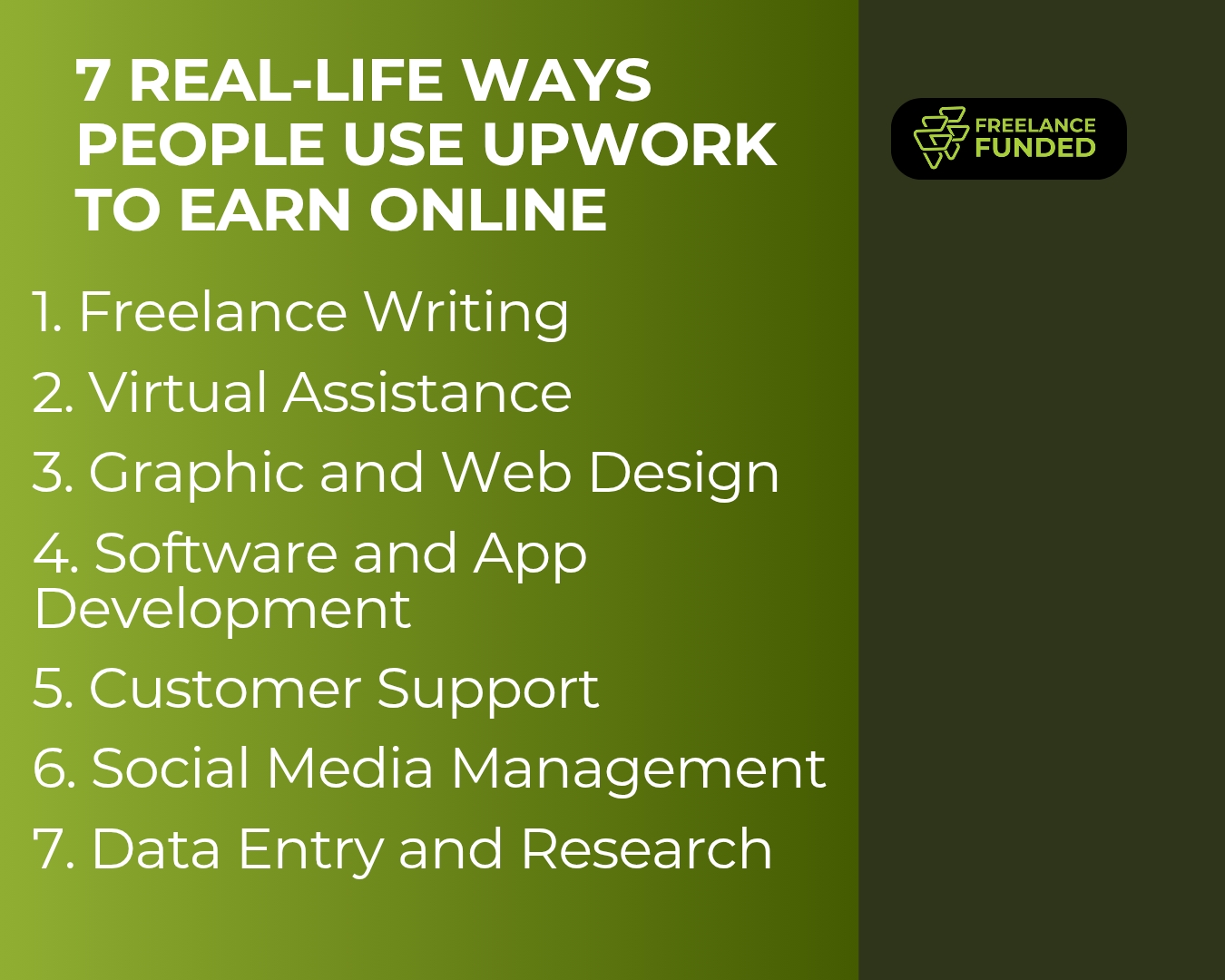
7 real-life ways people use Upwork to earn online include offering freelance writing services, providing virtual assistance, designing graphics and websites, handling customer support, developing apps, managing social media, and doing data entry. Each of these roles can be done remotely, making Upwork a go-to platform for anyone looking to work from home or build a flexible online income.
1. Freelance Writing
Freelance writers create blog posts, website content, email newsletters, white papers, and even eBooks for clients in need of content. On Upwork, you can earn per word, per article, or hourly—depending on your niche (e.g., finance, health, SaaS), with top writers charging anywhere from $25 to $100/hour.
2. Virtual Assistance
Virtual assistants help clients with administrative tasks like calendar management, inbox sorting, research, data entry, and client communication. Businesses pay anywhere from $8 to $40/hour for VAs who are organized, proactive, and able to handle multiple responsibilities remotely.
3. Graphic and Web Design
From logos to UI/UX mockups and full websites, designers are in constant demand. Whether you specialize in tools like Figma or Adobe Illustrator, design gigs on Upwork can range from $15 to $100+/hour based on your skill level and portfolio.
4. Software and App Development
This includes building websites, mobile apps, APIs, and custom tools for clients. If you know languages like Python, JavaScript, or PHP, or you specialize in frameworks like React or Flutter, you can land high-paying jobs, often ranging from $30 to $150/hour.
5. Customer Support
Support roles involve handling live chat, email queries, and customer issues for companies—especially e-commerce or SaaS businesses. These roles are often long-term, paying $10 to $30/hour depending on your experience and language proficiency.
6. Social Media Management
Social media managers create content, schedule posts, respond to comments, and grow client accounts on platforms like Instagram, TikTok, LinkedIn, or Twitter. Rates vary, but professionals can earn $300–$2,000/month per client depending on the service package offered.
7. Data Entry and Research
Clients frequently need help gathering leads, updating spreadsheets, verifying data, or conducting online research. While it’s a beginner-friendly category, consistent jobs at $5 to $20/hour can quickly add up when you work with long-term clients.
Can You Really Earn Money on Upwork?
Yes, you can really earn money on Upwork, and thousands of freelancers do it every day, across multiple categories and skill levels.
Whether you’re a beginner or an experienced professional, Upwork provides real opportunities to get paid for your services. The platform supports remote freelance work in fields like writing, graphic design, web development, customer service, marketing, translation, virtual assistance, and more. Some freelancers make $500 to $2,000/month part-time, while others scale to full-time six-figure incomes through long-term contracts, recurring clients, and agency models.
To earn reliably on Upwork in 2025:
- Niche down into high-demand, low-competition skills to stand out.
- Craft an optimized Upwork profile using targeted keywords related to your service.
- Send personalized proposals that address the client’s project specifically.
- Get early reviews by starting with smaller jobs to build your reputation fast.
- Use Upwork’s filters to find high-quality jobs posted by verified clients.
- Stay consistent — the more you apply, the better your chances of getting hired.
Upwork is not a get-rich-quick platform, but it rewards professionalism, consistency, and niche expertise. It’s one of the most trusted platforms for online freelancing jobs, especially for beginners building a career remotely.

What Are the Uses of Upwork?
Upwork is primarily used as a digital marketplace that connects freelancers with clients who need professional services. However, its uses go far beyond simply applying for jobs. Understanding the different ways Upwork can be used helps freelancers maximize the platform properly.
First, Upwork is used to find both short-term and long-term paid work. Freelancers offer services such as writing, graphic design, programming, marketing, video editing, virtual assistance, consulting, and many other professional skills. Clients post job listings, review proposals, and hire talent directly through structured contracts.
Second, Upwork is used to manage contracts and payments securely. Instead of relying on informal agreements, freelancers and clients operate under official contracts. The platform handles invoicing, escrow protection for fixed-price jobs, time tracking for hourly contracts, and dispute resolution. This reduces financial risk and administrative stress.
Third, Upwork is used to build professional credibility. Freelancers accumulate verified reviews, ratings, and a Job Success Score. These public performance indicators act as proof of reliability. Over time, this reputation becomes a powerful business asset.
Finally, Upwork is used as a long-term client acquisition channel. Many freelancers begin by applying manually to jobs. As their profiles strengthen, clients start finding them through search and sending direct invitations. At that stage, Upwork becomes less about bidding and more about inbound opportunities.
Do You Need Experience to Start Freelancing on Upwork?
No, you do not need years of formal professional experience to start freelancing on Upwork, but you do need demonstrable skill. Upwork does not require degrees or corporate backgrounds. Clients are primarily interested in whether you can solve their problem effectively.
Many beginners assume they must have traditional work experience before joining. In reality, clients value results over job titles. If you can show samples of your work, even self-created portfolio projects, you can compete successfully.
However, a lack of experience requires smart positioning. Beginners benefit from targeting smaller projects first, where expectations are clear, and competition is manageable. This builds momentum and allows you to accumulate reviews.
The key is preparation. Build a focused profile. Upload relevant samples. Clearly explain the specific problem you solve. Each completed project gradually replaces your initial lack of experience with documented proof.
What Are the Pros and Cons of Using Upwork?
Upwork has clear advantages and disadvantages. Understanding both helps freelancers decide whether it aligns with their goals
One major advantage is structured payment protection. Escrow funding and hourly tracking significantly reduce non-payment risk compared to informal freelance arrangements.
Another advantage is global access. Freelancers can work with international clients without relying on local business networks. This expands income potential dramatically.
Upwork also offers built-in reputation systems. Reviews, ratings, and Job Success Scores strengthen credibility over time and increase hiring probability.
However, competition can be high, particularly in saturated skill categories. Beginners may struggle initially if their profiles lack clarity or positioning.
Upwork also charges service fees on earnings. While these fees fund payment protection and infrastructure, they reduce take-home income.
Additionally, the Connect system requires strategic application. Without discipline, freelancers may overspend on proposals.
Overall, the advantages outweigh the disadvantages when the platform is used intentionally rather than casually.
Can Upwork Be a Full-Time Career?
Yes, Upwork can become a full-time career when approached as a business rather than a side experiment. Thousands of freelancers earn a consistent monthly income exclusively through Upwork contracts.
The progression usually follows a pattern. In the beginning, freelancers apply frequently and compete actively. As reviews accumulate and Job Success Scores improve, trust increases. Repeat clients and long-term contracts begin to replace constant bidding.
Eventually, some freelancers receive steady invitations and recurring projects. At this stage, Upwork functions as a stable income channel rather than a job search platform.
However, sustainability requires professionalism. Freelancers must manage finances, maintain strong communication, deliver high-quality work consistently, and continue improving their skills.
Upwork provides the infrastructure. Long-term success depends on discipline and strategic thinking.
How to Get Started on Upwork Today
Getting started on Upwork requires strategy, not just registration.
First, choose one primary service to offer. Avoid listing multiple unrelated skills. Clear specialization improves search visibility and client trust.
Second, create a focused profile headline and overview. Your headline should clearly state your core skill. Your overview should explain what problem you solve and how clients benefit from hiring you.
Third, upload strong portfolio samples. If you do not yet have paid client work, create sample projects that demonstrate your ability.
Fourth, apply selectively to relevant job posts. Instead of sending large volumes of generic proposals, send fewer but stronger proposals tailored to each client’s needs.
Finally, stay consistent. Early results may take time, but consistent effort builds traction and visibility.
Conclusion: Is Upwork Worth It for Freelancers in 2026?
Yes, Upwork remains worth it for freelancers in 2026 when approached strategically. Demand for remote digital services continues to grow globally, and businesses actively seek specialized talent online.
Upwork is not a shortcut to instant income. It is a structured marketplace that rewards clarity, competence, and professionalism. Freelancers who understand how contracts, Connects, reputation systems, and positioning work can build reliable income streams.
For beginners, Upwork offers a safer starting point than independent outreach because of its payment protection and structured contracts. For experienced freelancers, it serves as a stable and scalable client acquisition channel.
Ultimately, Upwork’s value depends on how it is used. When treated as a serious business platform rather than a quick-money opportunity, it remains one of the strongest freelancing platforms available in 2026.